Uncover the Truth
Explore our curated original stories and real-world knowledge spanning Sanatan Dharma, Cosmic Horror, Science, and the nature of our reality.
The Core Pillars Live Knowledge
Quantum mechanics
Quantum mechanics, also known as quantum physics, is the fundamental physical theory that describes the behavior of matter and of light; the behaviors it models typically occur at and below the scale of atoms, and have often been described as counterintuitive. Its concepts and methods have been applied across many disciplines, including quantum chemistry, quantum biology, quantum field theory, quantum technology, and quantum information science. Quantum mechanics can describe many systems that classical physics cannot. Classical physics can describe many aspects of nature at an ordinary (macroscopic and (optical) microscopic) scale; however, it is insufficient for describing them at very small submicroscopic (atomic and subatomic) scales. Classical mechanics can be derived from quantum mechanics as an approximation that is valid at ordinary scales. Quantum systems have bound states that are quantized to discrete values of energy, momentum, angular momentum, and other quantities, in contrast to classical systems where these quantities can be measured continuously. Measurements of quantum systems show characteristics of both particles and waves (wave–particle duality), and there are limits to how accurately the value of a physical quantity can be predicted prior to its measurement, given a complete set of initial conditions (the uncertainty principle). Quantum mechanics arose gradually from theories to explain observations that could not be reconciled with classical physics, such as Max Planck's solution in 1900 to the black-body radiation problem, and the correspondence between energy and frequency in Albert Einstein's 1905 paper, which explained the photoelectric effect. These early attempts to understand microscopic phenomena, now known as the "old quantum theory", led to the full development of quantum mechanics in the mid-1920s by Niels Bohr, Erwin Schrödinger, Werner Heisenberg, Max Born, Paul Dirac and others. The modern theory is formulated in various specially developed mathematical formalisms. In one of them, a mathematical entity called the wave function provides information, in the form of probability amplitudes, about what measurements of a particle's energy, momentum, and other physical properties may yield.
Sanatana Dharma
Bhagavad Gita
The Bhagavad Gita (; Sanskrit: भगवद्गीता, IPA: [ˌbʱɐɡɐʋɐd ˈɡiːtaː], romanized: bhagavad-gītā, lit. 'God's song'), often referred to as the Gita (IAST: Gītā), is a Hindu scripture, likely composed in the second or first century BCE, which forms part of the epic poem Mahabharata. The Bhagavad Gita is a synthesis of various strands of Indian religious thought, including the Vedic concept of dharma (duty, rightful action); Sankhya-based yoga and jñana (knowledge); and bhakti (devotion). Among the Hindu traditions, the Bhagavad Gita holds a unique pan-Hindu influence as the most prominent sacred text and is a central text in the Vedanta and Vaishnava traditions. While traditionally attributed to the sage Veda Vyasa, the Bhagavad Gita is historiographically regarded as a composite work by multiple authors. Incorporating teachings from the Upanishads and the Samkhya Yoga philosophy, the Bhagavad Gita is set in a framework of dialogue between the Pandava prince Arjuna and his charioteer guide Krishna, an avatar of Vishnu, at the onset of the Kurukshetra War. While the Bhagavad Gita praises the benefits of yoga in releasing man's inner essence from the bounds of desire and the wheel of rebirth, the text stresses the Brahmanic idea of living according to one's duty or dharma, in contrast to the ascetic ideal of seeking liberation by avoiding all karma. Facing the perils of war, Arjuna hesitates to perform his duty (dharma) as a warrior. Krishna persuades him to commence in battle, arguing that while following one's dharma, one should not consider oneself to be the agent of action, but attribute all of one's actions to God (bhakti). Numerous classical and modern thinkers have written commentaries on the Bhagavad Gita with differing views on its essence, and the relation between the individual self (jivatman) and the supreme self (Atman/Brahman) or God (Krishna). The Krishna-Arjuna dialogue has been construed as a metaphor for an immortal dialogue between the individual and the supreme self. The Bhagavad Gita's setting in a battlefield has been interpreted by many scholars as an allegory for the struggles and vagaries of human life.
Lovecraftian horror
Lovecraftian horror, also called cosmic horror or eldritch horror, is a subgenre of horror, fantasy, and weird fiction originating from the United States that emphasizes the horror of the unknowable and incomprehensible more than gore or other elements of shock. It is named after 20th-century American author H. P. Lovecraft, whose work emphasizes strange and eldritch (unnatural) phenomena, with themes of cosmic dread, forbidden and dangerous knowledge, madness, non-human influences on humanity, religion and superstition, fate and inevitability, and the risks associated with scientific discoveries, which are now associated with Lovecraftian horror as a subgenre. The cosmic themes of Lovecraftian horror can also be found in other media, notably horror films, horror games, and comics.
Original Stories Observer Studio
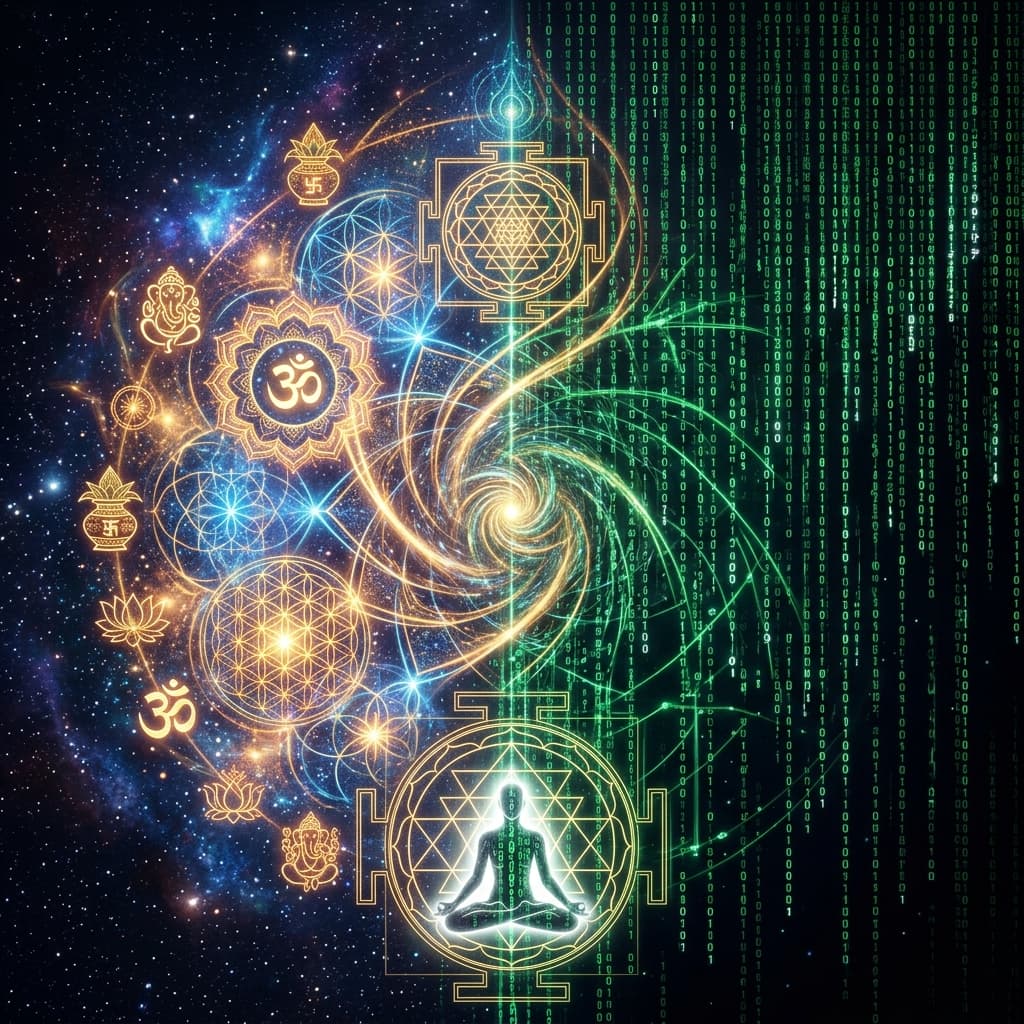
The Illusion of Reality: Matrix and Sanatan Dharma
How the ancient texts describe the simulation we are living in.

The Depths of Cosmic Horror
When we stare into the void, what stares back?
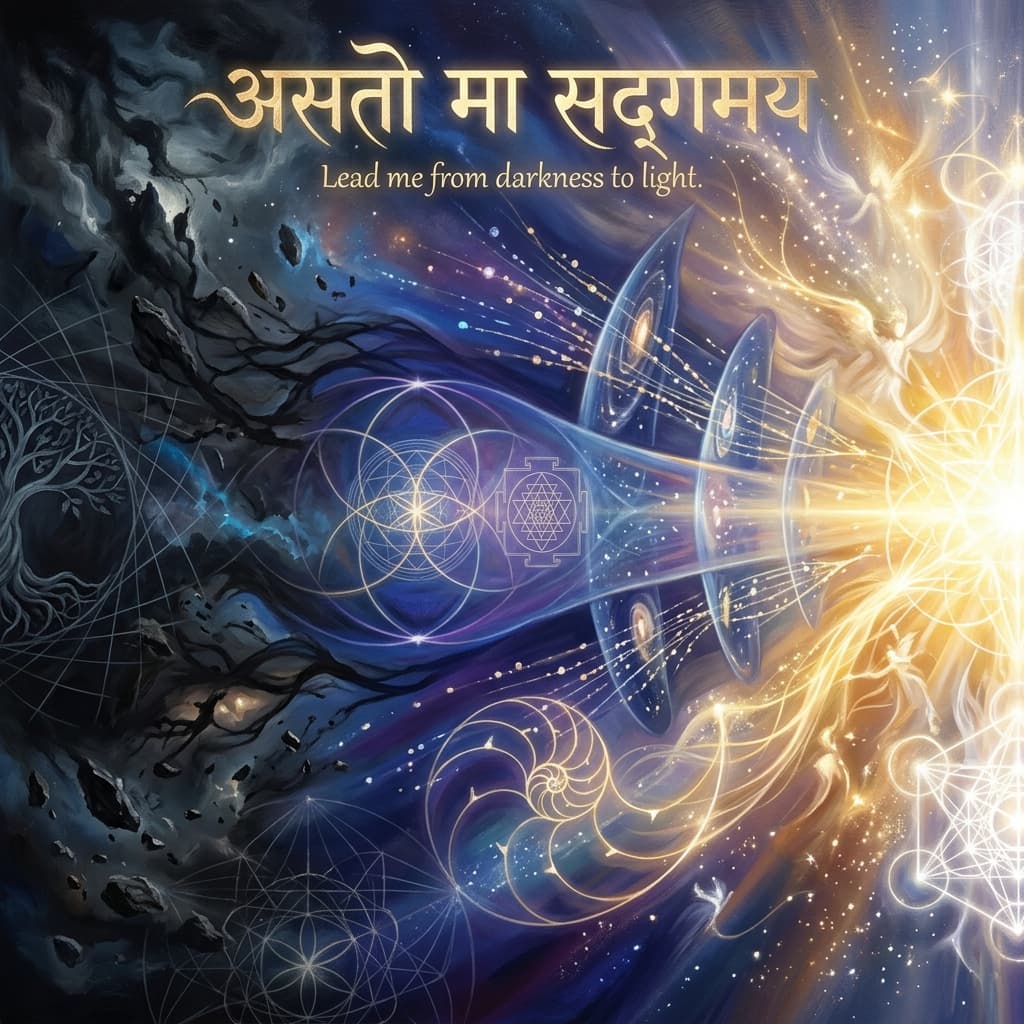
From Ignorance to Truth
Decoding the ancient mantra of realization and awakening.
Free Sanatan Resources & Yatra Bookings
Free Scriptures
Read the Bhagavad Gita, Upanishads, and other Sanatan Dharma texts for free via Gita Press and Internet Archive.
Gita PressChar Dham Yatra
Official portals for Char Dham bookings, registrations, and Kedarnath-Badrinath travel information.
Official Booking